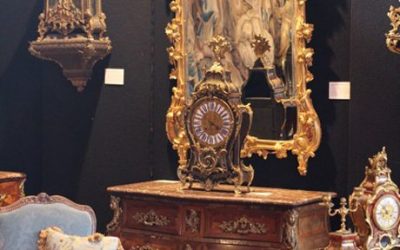
18TH CENTURY REGENCE PERIOD ORMOLU-MOUNTED AND BRASS BOULLE INLAID TORTOISESHELL STRIKING BRACKET CLOCK. L. GODDE LAISNE PARIS 1720

During his own lifetime, Boulle was commissioned to make replicas of some of the great pieces made for both the King and the Court, sometimes only slightly altering the designs. After his death in 1732, Boulle’s sons, who had been running the workshops since 1715, continued to produce pieces using their father’s techniques and models, and demand for Boulle-marquetried furniture continued throughout the 18th century. Boulle marquetry was at the height of fashion in the time of Louis XVI when the style of the Sun King, Louis XIV, underwent a revival. From this time, great makers such as Levasseur and Baumhauer created their own versions of Boulle’s originals and adapted the decorative techniques to furniture forms popular during their own time.
French Antiques And 18th Century French Commodes

Originally, in French furniture, a commode introduced about 1700 meant a low cabinet, or chest of draws at the height of the dado rail (à hauteur d’appui). A commode, made by an ebeniste (cabinet-maker ) and applied with gilt bronze mounts, was a piece of veneered case furniture much wider than it was high, raised on high or low legs and with (commode à vantaux) or without enclosing drawers. The piece of furniture would be provided with a marble slab top, selected to match the marble of the chimney piece. A commode occupied a prominent position in the room for which it was intended: it stood against the pier between the windows, in which case it would often be surmounted by a mirror glass, or a pair of identical commodes would flank the chimneypiece or occupy the center of each end wall. Bombé commodes, with surfaces shaped in three dimensions were a feature of the rococo style called “Louis Quinze” (Louis XV).